









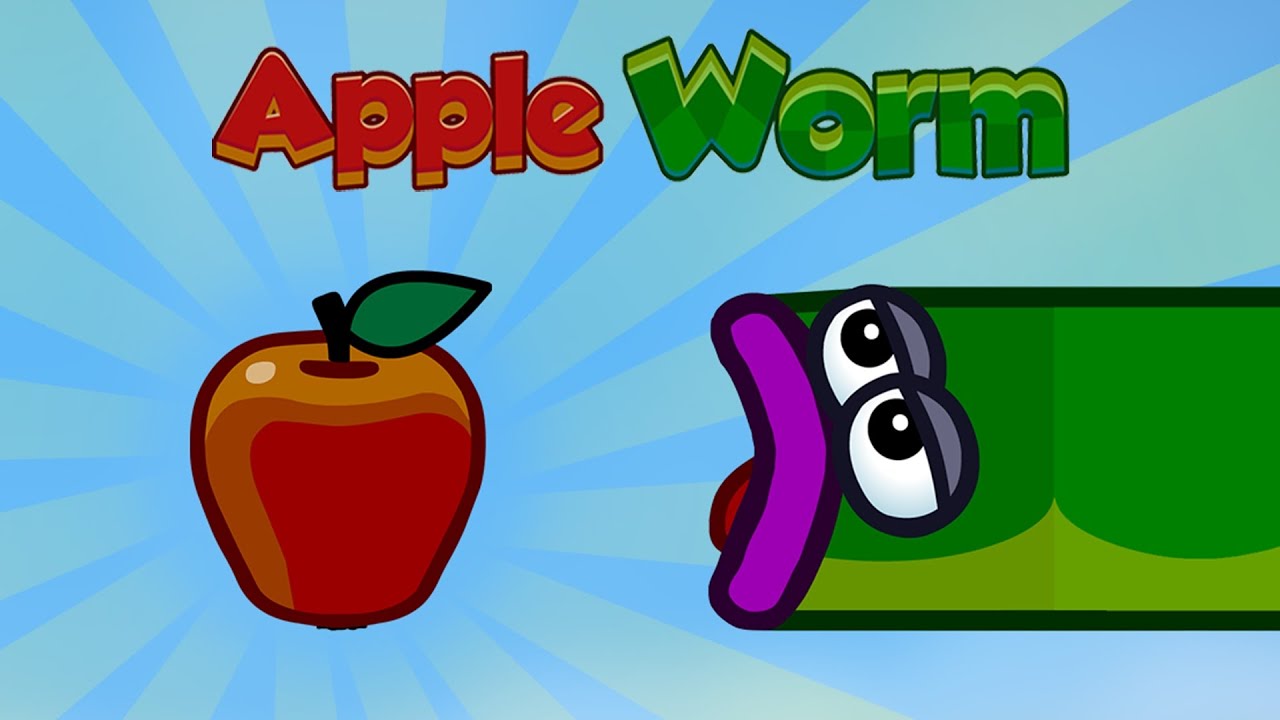
1. Apple Worm Game Overview
Apple Worm is a beautifully elegant puzzle game that takes a deceptively simple concept — guide a worm to eat apples and reach the exit — and layers onto it a set of physical constraints that make every level a genuine spatial reasoning challenge. Your worm grows longer with each apple consumed, and that growth is simultaneously your tool for overcoming obstacles and your greatest liability for getting stuck. Managing the relationship between your worm's ever-changing length and the increasingly complex terrain it must navigate is the central puzzle that Apple Worm is built around.
What distinguishes Apple Worm from typical maze or navigation games is how fundamentally the worm's body participates in the puzzle. Your length isn't just a score metric — it's a physical object occupying grid space that affects which paths remain accessible, which gaps can be bridged, and whether the exit can be reached at all given the route you've taken. A worm that ate apples in the wrong order might find itself too long to fit through the only remaining passage to the exit, or too short to bridge a gap that now separates it from its goal. Every apple and every movement decision has cascading consequences.
The game rewards the kind of careful, deliberate planning that action games rarely encourage. Observing the full level layout before moving, mentally simulating several moves ahead, identifying which apples must be eaten in which order — these pre-movement habits are what separate players who solve levels on the first or second attempt from those who repeatedly back themselves into inescapable corners. Moving slowly and thoughtfully through even simple-looking levels is almost always the right approach; the puzzles are designed to punish confidence and reward caution.
Apple Worm is a puzzle game that respects your intelligence and rewards your patience — a rare and refreshing combination.
Key Details:
- Genre: Puzzle / Logic / Strategy
- Difficulty Level: Medium to Hard (level complexity escalates significantly)
- Average Play Time: 10–25 minutes per session
- Best For: Fans of spatial logic puzzles and brain teasers, players who enjoy methodical problem-solving, anyone who appreciates puzzles where every decision has meaningful consequences
2. How to Play Apple Worm
Getting Started:
1. Study the full level layout before making any moves — identify all apple locations, gap positions, narrow passages, and the exit door.
2. Plan your apple collection order based on which sequence keeps your growing body out of the paths you'll need later.
3. Use arrow keys (desktop) or directional buttons (mobile) to move the worm — each move shifts the entire body one grid cell in the chosen direction.
4. Eat apples by moving your worm's head onto the cell they occupy — each apple adds one segment to your worm's body length.
5. Once all required apples are eaten, navigate to the exit to complete the level — ensuring your worm's full body length can reach the exit without getting trapped.
Basic Controls:
- Arrow Keys (Desktop) — move the worm up, down, left, or right one cell at a time
- On-Screen Directional Buttons (Mobile) — same directional movement via touchscreen controls
Objective:
Eat all required apples in each level to grow your worm to the necessary length, then navigate to the exit without getting stuck, trapped in a corner, or falling into gaps. Plan apple collection order carefully — the sequence matters as much as reaching each apple, since your growing body must always have a viable path to the exit.
3. Apple Worm Features & Highlights
- Body-Length-as-Puzzle-Mechanic — Your worm's growing length is simultaneously a tool for bridging gaps and an obstacle that restricts movement options, creating a uniquely dynamic puzzle constraint that changes with every apple eaten
- Apple Sequence Planning — The order in which apples are collected determines whether your grown body can still reach the exit — turning collection order into a central strategic variable that most movement games ignore entirely
- Grid-Based Movement with Physical Consequence — Every move has a permanent effect on your body's position in the level's space, with no undo — encouraging thorough pre-movement planning over reactive trial-and-error
- Escalating Level Complexity — Levels grow progressively more intricate with narrower passages, more precise apple sequencing requirements, and more demanding exit navigation challenges that reward accumulated puzzle intuition
- Multi-Platform Controls — Equally playable with keyboard arrow keys on desktop and touch directional controls on mobile, with no quality difference between the two input methods
4. Apple Worm Tips & Strategies
Beginner Tips:
- Observe the entire level before your first move: The single most valuable habit in Apple Worm is spending 10–15 seconds studying the full map before touching any directional input. Identify where all apples are, where the exit is, where the gaps are, and which passages are narrow enough that body length will matter when you reach them.
- Always leave yourself room to turn around: Moving into a narrow passage before confirming there's an escape route is the most common cause of getting irreversibly stuck. Before entering any confined area, verify that your current and anticipated body length will allow a full reversal if the path ahead doesn't work out.
- Move one step at a time — never in rapid sequences: Each individual move changes your body's position in ways that affect all future moves. Rapid movement sequences make it easy to miss the moment when a critical path closes off. Make one deliberate move, assess the new position, then make the next.
Advanced Strategies:
- Work backward from the exit to plan your approach: Before deciding which apple to eat first, trace the path from your anticipated final body length to the exit. Knowing which passage your full-length worm needs to navigate to reach the exit tells you which areas must remain clear when you're at maximum length — and therefore which apples must be eaten last.
- Use your tail as a temporary bridge: In levels where gaps must be crossed, your worm's body can span a gap and allow the head to cross to the other side before the tail segment clears — effectively using your length as a physical bridge. Identifying opportunities to use this technique is a key advanced skill that unlocks solutions to levels that appear impossible at first inspection.
- Eat apples that restrict future movement last: If a particular apple, when eaten, places your body segment in a position that blocks a key passage, save that apple for last — after you've navigated the passage it would otherwise block. Sequencing apples by their impact on future maneuverability is the advanced planning habit that separates first-attempt solutions from repeated failures.
What to Watch Out For:
- Moving too deep into narrow passages before confirming body length fits: A narrow corridor that comfortably accommodates a 5-segment worm may be completely impassable for a 9-segment worm after three more apples are eaten. Always factor in your anticipated body length at the point you'll navigate each tight passage, not just your current length.
- Assuming the straightest path to the exit is the correct one: Apple Worm's level design specifically places apples and obstacles to make the intuitively obvious route wrong. The direct path to the exit frequently requires passing through the very areas that later apple collection will block off. Trust the puzzle's design — if the obvious route looks too easy, it's almost certainly a trap.
5. Apple Worm Game Elements Explained
Body Growth & Length Management System
The body growth system is Apple Worm's defining mechanic and the source of all its puzzle complexity. Each apple the worm eats adds one segment to the tail end of the body — a segment that occupies real grid space, follows the exact path the body took to arrive at its current position, and physically affects which cells are available for future movement. This growth is permanent within a level: once a body segment exists, it cannot be removed until the worm moves far enough that the tail naturally clears a given cell. The consequence of this system is that every apple eaten makes the puzzle harder — not just because the worm is longer and harder to maneuver, but because the newly added tail segment now occupies space that was previously available as a movement option. Managing the tension between needing to eat apples (to grow and reach the exit) and not wanting to eat them (because growth restricts movement) is the fundamental strategic challenge of every level. Players who recognize this tension early — treating each apple as a deliberate decision with spatial consequences rather than a collectible to grab opportunistically — develop the planning habits that solve complex levels efficiently.
Apple Sequencing & Collection Order Strategy
The apple sequencing system elevates Apple Worm from a simple navigation puzzle to a genuine logic challenge by making the order of apple collection as important as the path taken to reach each one. In most levels, eating apples in different sequences produces dramatically different body configurations — and only certain configurations leave the worm positioned to navigate to the exit. A level that appears to have multiple valid routes to all apples often has only one sequence that doesn't result in the worm trapping itself. Discovering that sequence is the puzzle's core intellectual challenge. The skills required are spatial reasoning (predicting where body segments will be after future moves), forward planning (thinking through the state of the board several moves ahead), and consequence analysis (evaluating which apple sequence leaves the most future movement options open). These skills develop progressively through play — each failed attempt at a complex level provides information about why a particular sequence doesn't work, progressively narrowing the solution space toward the one sequence that does.
Level Architecture & Progression Design
Apple Worm's level design is the game's most carefully crafted element — each level a precisely engineered spatial puzzle with a specific intended solution path that rewards exactly the planning habits the game is teaching. Early levels are simple enough to solve with minimal forward planning, allowing players to experience the basic mechanics and develop intuition for how body growth affects movement. As levels progress, the complexity escalates across several dimensions simultaneously: more apples requiring more precise sequencing, narrower passages demanding more accurate body-length calculation, more intricate gap configurations that require using the body as a bridge, and exit approaches that require threading a full-length worm through tight terrain without any margin for error. The difficulty curve is honest and graduated — no level introduces complexity that hasn't been encountered in simpler form in previous stages — but the cumulative effect of these escalating demands is that later levels are genuinely hard and require the full application of every spatial reasoning skill the earlier levels developed. This honest escalation is what makes Apple Worm's hardest levels feel earned when solved rather than arbitrary when stuck.
6. Apple Worm FAQ
Q: How do I control the worm in Apple Worm?
A: On desktop, use the four arrow keys to move the worm one grid cell at a time in the corresponding direction — up, down, left, or right. Each key press moves the entire worm body one step, with the head moving first and all body segments following the path the head traced. On mobile, use the on-screen directional buttons to achieve the same movement. Move deliberately — one step at a time — rather than holding keys down for rapid movement, as each individual step changes the board state in ways that matter for subsequent decisions.
Q: What happens if the worm gets stuck?
A: If the worm reaches a position where no valid move is available — every adjacent cell is occupied by a body segment, a wall, or a gap — the level must be restarted. Unlike some puzzle games, Apple Worm has no undo button or step-back option: each move is permanent within the level run. When stuck, restart the level and apply the insight from the failed attempt — identify exactly which move created the inescapable position and plan a different sequence that avoids that outcome.
Q: Does the order I eat apples matter?
A: Yes — significantly. The order of apple collection determines where your body segments are positioned at each subsequent stage of the level, and only certain sequences leave your growing worm positioned to navigate the remaining terrain and reach the exit. Many levels have only one correct apple collection sequence (or a small number of equivalent sequences) that doesn't result in a dead end. If you've eaten all apples but can't reach the exit, the collection order was the issue — restart and try a different apple sequence.
Q: How do I cross gaps in Apple Worm?
A: Gaps are open cells that the worm falls through if its head enters them without body support. The primary gap-crossing technique uses your worm's own body as a bridge: if your body is long enough, you can position it to span the gap and allow your head to cross to the other side while your body still occupies the spanning cells. This technique requires sufficient body length (gained from eating apples) and careful positioning to ensure the bridge is in place before the head attempts to cross. Some levels are specifically designed around this technique.
Q: Is Apple Worm suitable for young players?
A: Apple Worm is accessible to players of various ages, but its puzzle complexity — particularly in later levels — is better suited to players who enjoy methodical thinking and don't mind restarting levels multiple times to find the correct solution. The game has no time pressure, no violence, and clear visual design that makes it genuinely family-friendly. Younger players may find early levels enjoyable and approachable while finding later levels appropriately challenging — a natural difficulty filter that makes it suitable for mixed-age play.
7. Games Like Apple Worm
If you like Apple Worm, you might also enjoy:
- Poor Bunny - It shares short, skill-based stages where movement timing and route choices matter.
- Brain Test - It also rewards thinking around the obvious solution and planning before acting.
- Happy Glass - It has a similar puzzle setup feel where one clever plan solves the stage.